Screening night at Cinéma Bellevaux, Lausanne
Curated by guest Curator and Arts Writer Théo-Mario Coppola and CALM – Centre d’Art La Meute co-curating leadership Oriane Emery & Jean-Rodolphe Petter

Isadora Neves Marques, Becoming Male in the Middle Ages, 2022, courtesy Umberto Di Marino, Naples; and Portugal Film, Lisbon. Photo : Théo Dufloo.
‘An affinity of hammers does not assume we will automatically be attuned to others who arestopped by what allows us to pass through, even when we ourselves have the experience of beingstopped. We have to acquire that affinity. It is what we work toward.’ — Sara Ahmed*
Towards an Affinity of Hammers, the title of the project, refers to ‘An Affinity of Hammers’*, a seminal essay by prominent figure in intersectional studies and feminism Sara Ahmed addressing the silencing and censoring of critical feminist speech. From the idea according to which ‘affinity can be acquired through the work of chipping away at the system’ in relation to endured transphobia and adversity as examined by the author, the project addresses idiosyncratic contexts where the power of struggle is a vehicle for self-existence.
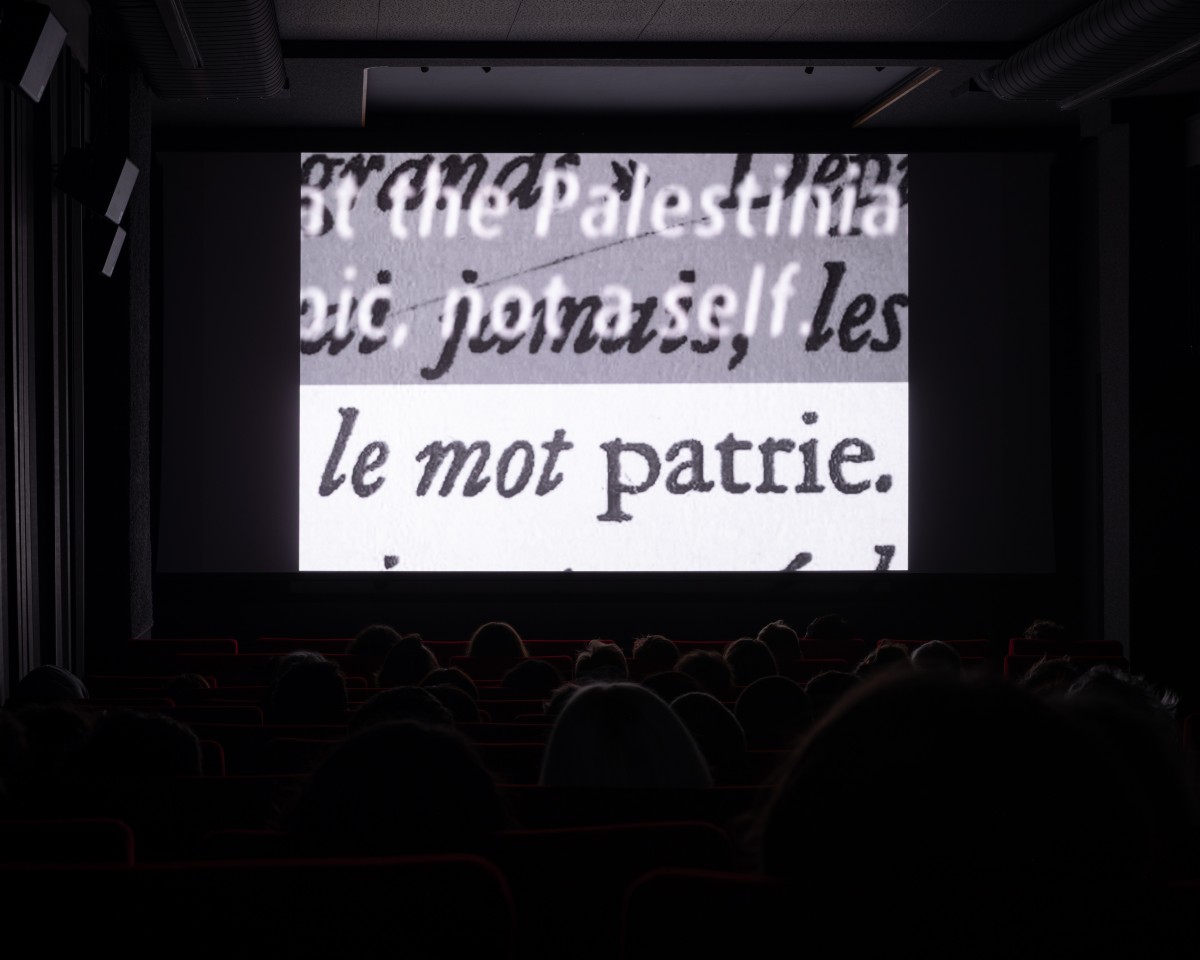
Taleb Lachheb, Le Meilleur Spectateur de la Pièce Historique qui se Joue sur Terre, 2024, courtesy of the artist. Photo : Théo Dufloo.
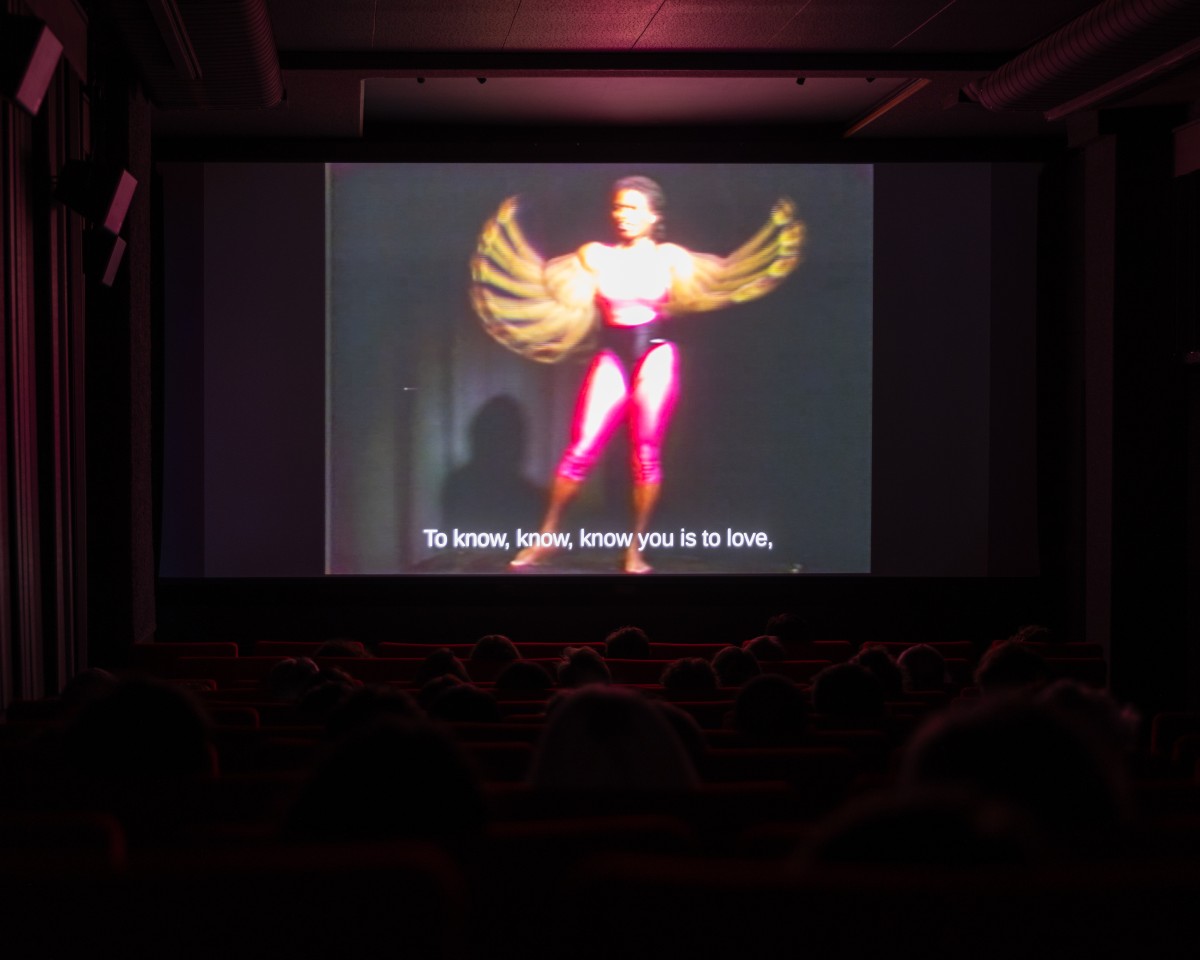
Barbara Hammer, The History of the World According to a Lesbian, 1988, courtesy Estate of Barbara Hammer, New York; Electronic Arts Intermix (EAI), New York; Company Gallery, New York; and KOW, Berlin. Photo : Théo Dufloo.
As a curatorial team, we are aware that giving voice to critical, rigorous and emancipatory aesthetic practices needs to be done from a firmly intersectional perspective. We consider the underlying issues of suffering and distress and emphasise the striking emotional force of struggle in what unites rather than divides. The reference to the hammer draws attention to the working tool, its powerful impact through its repetitive use, the noise and energy it generates, as well as the metaphors, comparisons and equivalents it evokes. Through the process of hammering, we learn the patience of struggle, its humility and the joy of being connected to other struggles. At the same time, we recognise other struggles that converge in our direction. In a tireless effort, we attune ourselves, as members of the same musical ensemble would, to the score and interpretation of a great global revolution or an aggregate of numerous and diverse uprisings.
Hammering is a manifestation of the tenacious insistence that characterises movements of struggle, initiatives of resistance and long-term protests, in contrast to the one-off, spectacular, high-profile events that most often define the discourse and portrayal of uprising. Here, time and action are not seen as distinct, special moments. Rather, they are seen as a continuous stream that flows across many lives, converging into a bigger scale of meaning that surpasses individuality and ego, and which reflects a shared state of being and its interconnectedness. In the selected works, empowerment and recognition of others, and the insurgent spirit that drives them, is reflected alternatively in individual fate, collective labour, community solidarity, shared loss and grief endured with others, whether it be an intimate experience or that of another person or group.

Fatxiya Ali Aden, Sarah Osman, Carole Roussopoulos, Femmes mutilées, plus jamais!, 2007, courtesy Collection du Fonds d'art contemporain de la Ville de Genève (FMAC) - Fonds André Iten; and Fonds Carole Roussopoulos, Médiathèque Valais – Martigny. Photo : Théo Dufloo.

Walid Raad, The dead weight of a quarrel hangs (still), 1996-1999, courtesy Collection du Fonds d’art contemporain de la Ville de Genève (FMAC) - Fonds André Iten. Photo : Théo Dufloo.

Théo-Mario Coppola, photo : Théo Dufloo.
This project as such could be considered as a form of hammering urging unconditional respect for others, improvement in the living conditions of the most vulnerable, and prioritising solidarity with people at risk in all aspects of life, including art as a place of work, production and discourse.Towards an Affinity of Hammers is also intended as a tribute to perseverance of principle and to obstinacy through action, which are reminders that history has no ending, struggle is repeated and perpetuated in the tiny becoming the great, and individuality converging into collective achievement.
Théo-Mario Coppola and Oriane Emery & Jean-Rodolphe Petter
*Ahmed, Sara, « An Affinity of Hammers », in Talia M. Bettcher et Susan Stryker, eds., Trans/Feminisms, Transgender Studies Quarterly (TSQ), volume 3, Issue 1-2, May 2016.